

 View Product ↗
01
Product Description
Technical details, material information and manufacturing notes for this product.
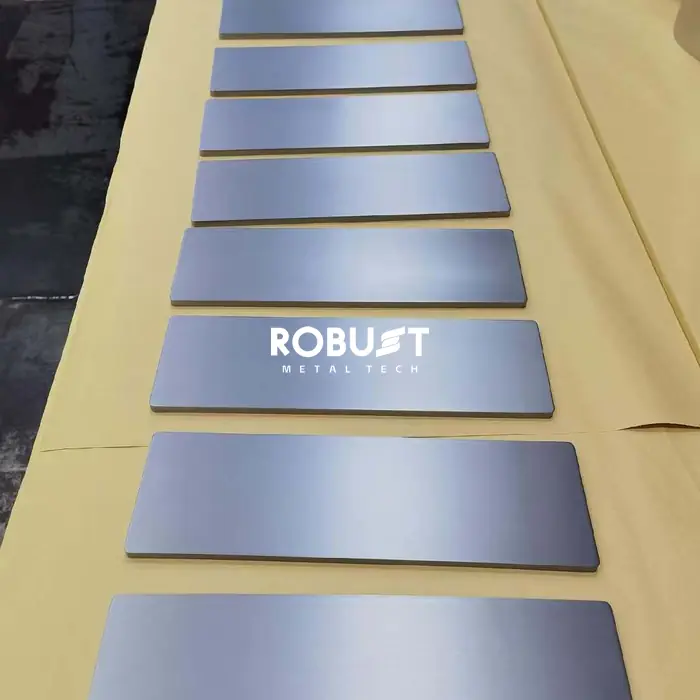
Niobium Plate & Sheet
Niobium plates and sheets (historically referred to as columbium) are flat-rolled refractory metal products.
Niobium belongs to the same group as tantalum and offers high melting point, low density, and superconducting capability.
It is widely used in aerospace, nuclear engineering, medical implants, and advanced vacuum systems.
1. Dimensional Standards (ASTM B393)
Under ASTM B393 standard, niobium flat products are classified by thickness range.
Niobium Foil / Strip
Thickness below 0.006 inch (0.15 mm).
Niobium Sheet
Thickness from 0.006 to 0.1875 inch (0.15 mm to 4.75 mm).
Niobium Plate
Thickness above 0.1875 inch (4.76 mm to 50+ mm).
2. Key Material Properties
Superconductivity at Cryogenic Temperatures
Niobium becomes a Type-II superconductor below 9.2 Kelvin.
It conducts electricity with zero resistance and no energy loss.
Excellent Formability
Niobium maintains high ductility at room temperature.
It can be deep-drawn, stamped, bent, and welded without cracking.
Corrosion Resistance & Biocompatibility
Niobium forms a stable oxide layer (Nb2O5) in air.
This gives strong resistance to acids and ensures medical-grade biocompatibility.
3. Standard Grades and Classifications
| UNS Grade | Material Type | Application |
| UNS R04200 | Reactor Grade Pure Niobium | Nuclear structural components with ultra-low impurity control. |
| UNS R04210 | Commercial Grade Niobium | Industrial chemical, vacuum furnace, and electronics applications. |
| UNS R04251 | Niobium-1% Zirconium | High-temperature strength for aerospace and structural systems. |
| UNS R04261 | Commercial Nb-1Zr Alloy | Used in lamp systems and aerospace shielding structures. |
| UNS R04220 | RRR High-Purity Niobium | Ultra-high purity superconducting grade (99.99%). |
4. Primary Industrial Applications
Superconducting RF Cavities
RRR niobium sheets are used in particle accelerator cavities.
They enable near-light-speed particle acceleration in CERN systems.
Aerospace & Rocket Structures
Niobium alloys like C-103 are used in rocket nozzles and heat shields.
They perform under extreme temperatures above 1,400°C.
Medical & MRI-Compatible Devices
Niobium sheets are biocompatible and non-magnetic.
They are widely used in implantable medical devices.
Electronics & Surface Anodizing
Niobium can be anodized to produce colorful oxide layers.
It is widely used in jewelry and precision electronic components.
04
Related Technical Resources
Material guides, application notes and manufacturing knowledge from ROBUST.
05