 View Product ↗
01
Product Description
Technical details, material information and manufacturing notes for this product.
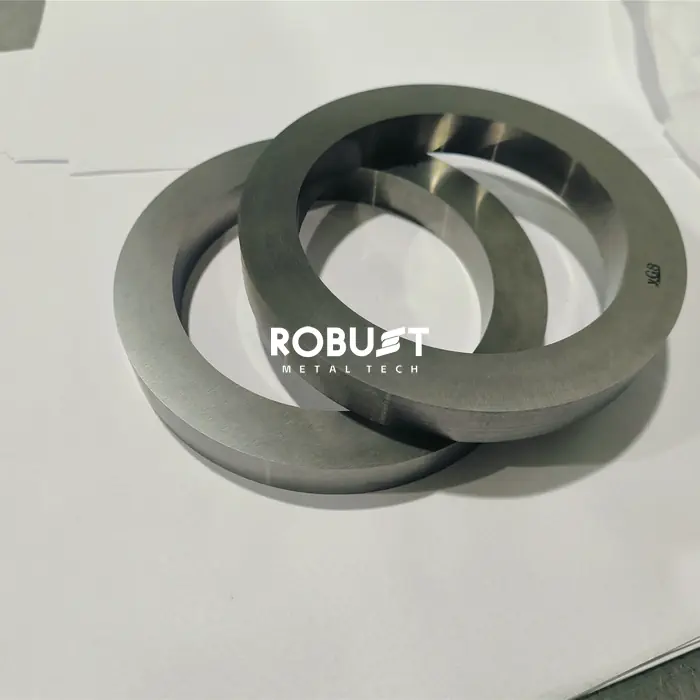
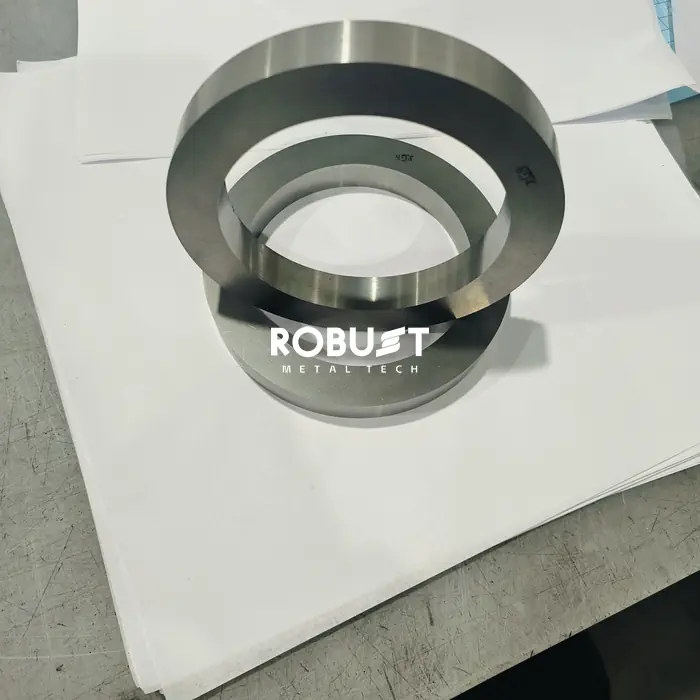
Cemented Carbide Ring Overview
Cemented carbide ring, commonly known as tungsten carbide or simply carbide, is a composite material consisting of hard carbide particles (primarily tungsten carbide, WC) bonded together by a metallic binder (usually cobalt, Co).
This combination results in cutting tools that are exceptionally hard, wear-resistant, and capable of operating at high temperatures and speeds.
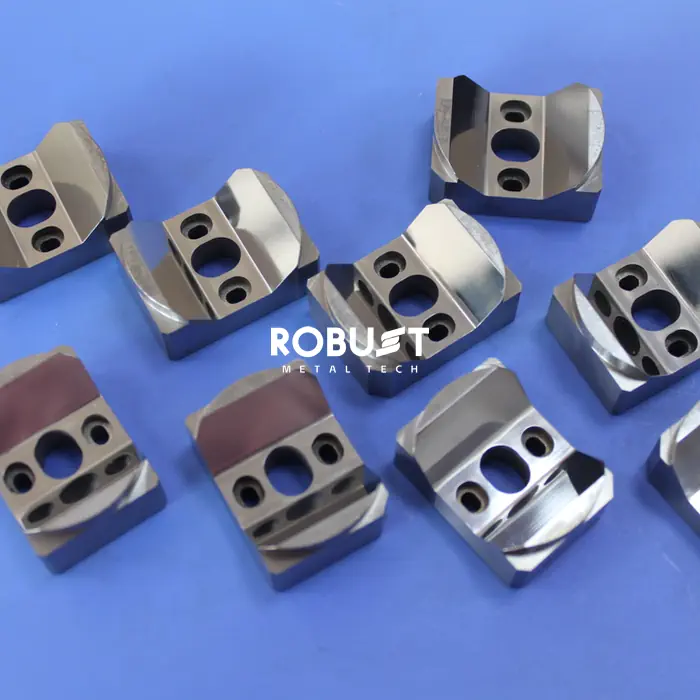
It is widely used as an industrial wear-resistant and precision component.
Material Structure
Cemented carbide is a composite material consisting of:
Hard Phase: Primarily Tungsten Carbide (WC) grains, which provide the hardness.
Binder Phase: Typically Cobalt (Co), though Nickel or Iron are sometimes used.
This structure “cements” the hard grains together, providing toughness and preventing brittleness.
Key Properties
Hardness: Typically ranges from 1200 to 2000 HV, far exceeding hardened tool steel.
Density: Very high (approx. 14.5 g/cm³), giving a heavy and solid structure.
Thermal Stability: Maintains performance up to 800°C.
Elastic Modulus: About 2–3 times stiffer than steel, reducing deformation under load.
Property | Description |
Hardness | Typically 1200–2000 HV, much higher than tool steel |
Density | Approx. 14.5 g/cm³, very high material density |
Thermal Stability | Stable cutting performance up to 800°C |
Elastic Modulus | 2–3 times stiffer than steel with low deflection |
04
Related Technical Resources
Material guides, application notes and manufacturing knowledge from ROBUST.
05